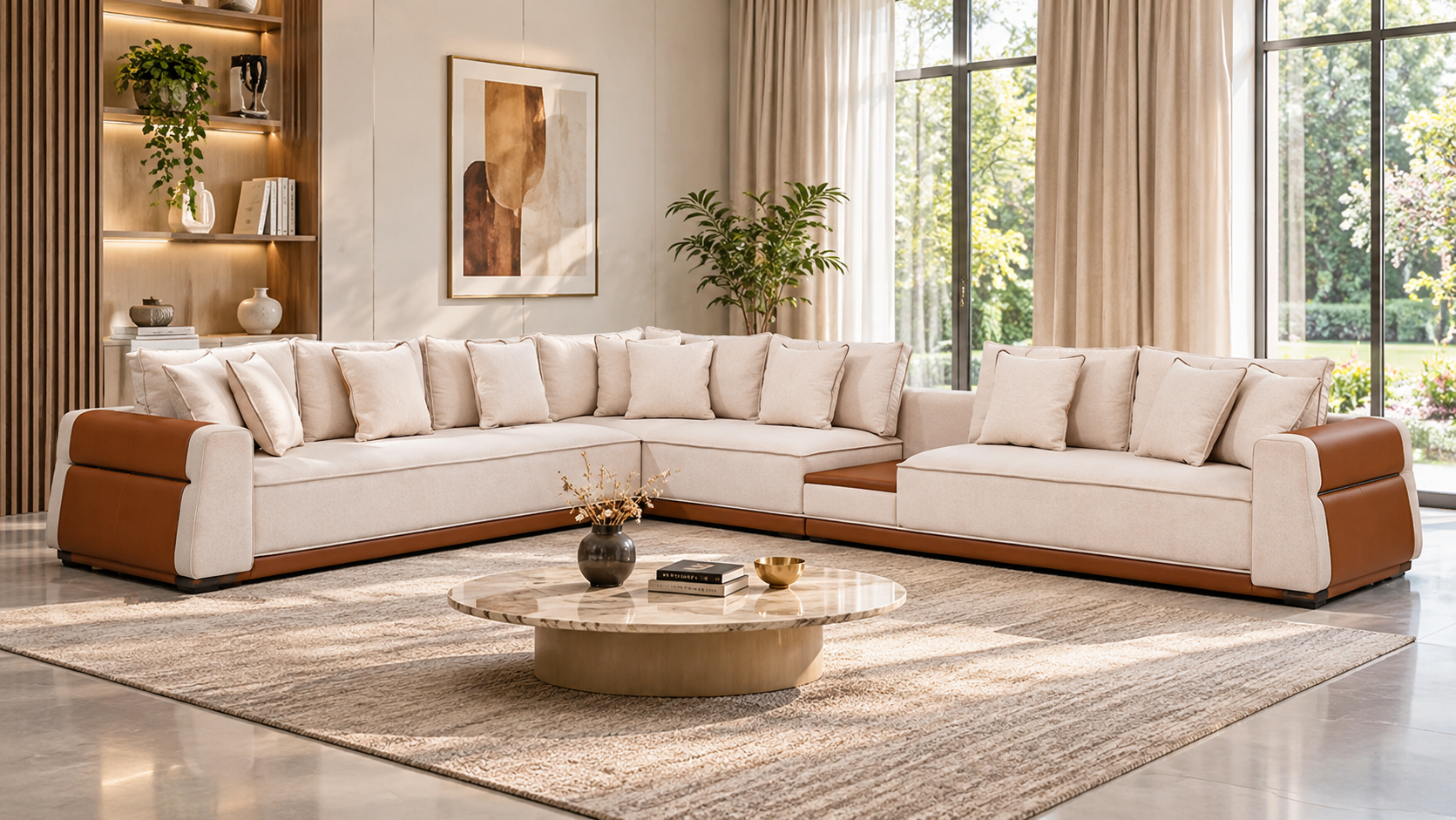
What Are the Main Sofa Set Designs for Living Room?
Most sofa sets fall into one of six design families. The style you choose sets the visual weight of the room and determines how much space you need around it.
This is the decision most people make based on images they've saved Pinterest boards, Instagram reels, a friend's house they liked. That's fine as a starting point. But the style has to fit the room's actual proportions, traffic flow, and how the space is used daily. A Chesterfield that looks incredible in a 20×15 ft drawing room can feel overwhelming in a 10×12 ft flat. A mid-century 3-seater that reads effortless in an open-plan space can look lost in a room with four walls pressing in.
Scroll through the six families below. For each one, consider not just whether you like it but whether your room has the ceiling height, natural light, and floor area to carry it.
Which Sofa Material Is Best for Indian Homes?
This is where most people go wrong. The sofa that feels perfect in a showroom can feel wrong within a year if the fabric isn't suited to your climate and household. Freedom Tree's guide on fabric vs leather for Indian homes is worth reading alongside the table below. Here is a plain breakdown of what works and what doesn't.
Indian homes face three conditions that most sofa fabric guides written for a Western climate don't account for. First, humidity particularly in coastal cities and during monsoon months, where moisture levels can sit above 80% for weeks at a time. Second, heat summers regularly exceed 38°C, which means a fabric that traps body heat becomes genuinely uncomfortable. Third, dust open windows and high foot traffic mean upholstery accumulates dust faster than in AC-sealed environments. Any fabric choice needs to hold up against all three, not just one.
The other variable most people underestimate is their household. A sofa in a home with young children, pets, or regular guests sees entirely different use than one in a compact apartment for one or two people. The "best" material depends on who is actually using the sofa, not on what looks most premium in a showroom.
"The fabric that feels right in an air-conditioned showroom can feel wrong in daily Chennai life. Choose for your home, not the display floor."
What About Leather Specifically?
Genuine leather is the single most misunderstood material in Indian home furniture. People worry that it won't survive humidity but full-grain leather is naturally resistant to moisture when maintained correctly (a leather conditioner once or twice a year is enough). What doesn't survive humidity is faux leather, bonded leather, and PU leather. These peel within 3–5 years as the adhesive layers separate in warm, humid air. The problem isn't leather, it's the imitation of it.
If you want a leather sofa and your home doesn't have central air conditioning, look for full-grain or top-grain leather and ask your supplier specifically about the tanning process and the backing material. A genuine leather sofa in a non-AC Chennai home will outlast a faux leather one in a fully climate-controlled apartment.
Velvet is the other material that needs careful consideration. It reads beautifully rich texture, deep colour, premium finish but it attracts dust aggressively and is almost impossible to maintain in an open-ventilation home. Reserve velvet for a formal drawing room that sees occasional use, not the main family sofa.
Standard Sofa Set Sizes: What Fits Your Living Room?
Most people decide on a sofa set design before they measure the room. Then they find out on delivery day that it's 30 cm too wide, or the L-shape blocks the door. Mark the footprint with tape on your floor before you order it takes five minutes and saves a very expensive mistake.
The measurements that matter most are not just the sofa's width they are the relationship between the sofa and everything else in the room. The distance between the sofa and the coffee table affects whether people can reach across it comfortably. The distance between the sofa and the TV determines whether the viewing distance is right. The clearance behind the sofa affects wall damage and air circulation. Get all three right, not just the sofa's footprint in isolation.
Indian living rooms often try to seat more people than the room's square footage can comfortably hold. The result is a sofa set for living room that is technically the right size but feels cramped because the walkways are too narrow. The rule of thumb: every walkway in the room should be at least 90 cm wide. Measure that first, then work backwards to what sofa size the remaining space allows.
